

大公社评英译/把「愿景」转化为「实景」 齐心建设更美好香港
- 字号
- 放大
- 标准
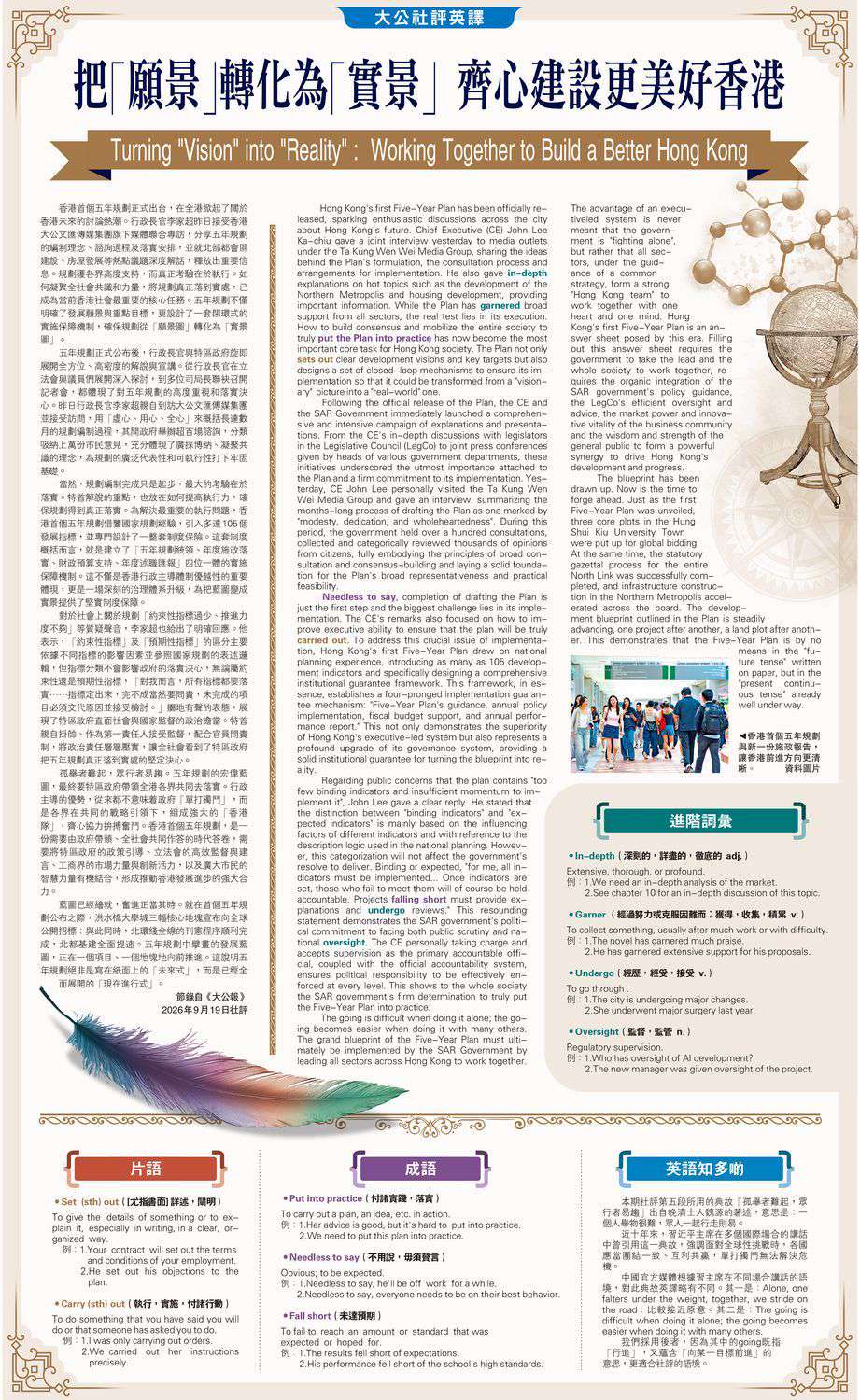
香港首个五年规划正式出台,在全港掀起了关于香港未来的讨论热潮。行政长官李家超昨日接受香港大公文汇传媒集团旗下媒体联合专访,分享五年规划的编制理念、咨询过程及落实安排,并就北部都会区建设、房屋发展等热点议题深度解话,释放出重要信息。规划获各界高度支持,而真正考验在于执行。如何凝聚全社会共识和力量,将规划真正落到实处,已成为当前香港社会最重要的核心任务。五年规划不仅明确了发展愿景与重点目标,更设计了一套闭环式的实施保障机制,确保规划从「愿景图」转化为「实景图」。
五年规划正式公布后,行政长官与特区政府旋即展开全方位、高密度的解说与宣讲。从行政长官在立法会与议员们展开深入探讨,到多位司局长联袂召开记者会,都体现了对五年规划的高度重视和落实决心。昨日行政长官李家超亲自到访大公文汇传媒集团并接受访问,用「虚心、用心、全心」来概括长达数月的规划编制过程,其间政府举办超百场咨询,分类吸纳上万份市民意见,充分体现了广采博纳、凝聚共识的理念,为规划的广泛代表性和可执行性打下牢固基础。
当然,规划编制完成只是起步,最大的考验在于落实。特首解说的重点,也放在如何提高执行力,确保规划得到真正落实。为解决最重要的执行问题,香港首个五年规划借鉴国家规划经验,引入多达105个发展指标,并专门设计了一整套制度保险。这套制度概括而言,就是建立了「五年规划统领、年度施政落实、财政预算支持、年度述职汇报」四位一体的实施保障机制。这不仅是香港行政主导体制优越性的重要体现,更是一场深刻的治理体系升级,为把蓝图变成实景提供了坚实制度保障。
对于社会上关于规划「约束性指标过少、推进力度不够」等质疑声音,李家超也给出了明确回应。他表示,「约束性指标」及「预期性指标」的区分主要依据不同指标的影响因素并参照国家规划的表述逻辑,但指标分类不会影响政府的落实决心,无论属约束性还是预期性指标,「对我而言,所有指标都要落实……指标定出来,完不成当然要问责,未完成的项目必须交代原因并接受检讨。」掷地有声的表态,展现了特区政府直面社会与国家监督的政治担当。特首亲自挂帅、作为第一责任人接受监督,配合官员问责制,将政治责任层层压实,让全社会看到了特区政府把五年规划真正落到实处的坚定决心。
孤举者难起,众行者易趋。五年规划的宏伟蓝图,最终要特区政府带领全港各界共同去落实。行政主导的优势,从来都不意味着政府「单打独斗」,而是各界在共同的战略引领下,组成强大的「香港队」,齐心协力拚搏奋斗。香港首个五年规划,是一份需要由政府带头、全社会共同作答的时代答卷,需要将特区政府的政策引导、立法会的高效监督与建言、工商界的市场力量与创新活力,以及广大市民的智慧力量有机结合,形成推动香港发展进步的强大合力。
蓝图已经绘就,奋进正当其时。就在首个五年规划公布之际,洪水桥大学城三幅核心地块宣布向全球公开招标;与此同时,北环线全线的刊宪程序顺利完成,北都基建全面提速。五年规划中擘画的发展蓝图,正在一个项目、一个地块地向前推进。这说明五年规划绝非是写在纸面上的「未来式」,而是已经全面展开的「现在进行式」。
节录自《大公报》
2026年9月19日社评
Turning "Vision" into "Reality":Working Together to Build a Better Hong Kong
Hong Kong's first Five-Year Plan has been officially released, sparking enthusiastic discussions across the city about Hong Kong's future. Chief Executive (CE) John Lee Ka-chiu gave a joint interview yesterday to media outlets under the Ta Kung Wen Wei Media Group, sharing the ideas behind the Plan's formulation, the consultation process and arrangements for implementation. He also gave in-depth explanations on hot topics such as the development of the Northern Metropolis and housing development, providing important information. While the Plan has garnered broad support from all sectors, the real test lies in its execution. How to build consensus and mobilize the entire society to truly put the Plan into practice has now become the most important core task for Hong Kong society. The Plan not only sets out clear development visions and key targets but also designs a set of closed-loop mechanisms to ensure its implementation so that it could be transformed from a "visionary" picture into a "real-world" one.
Following the official release of the Plan, the CE and the SAR Government immediately launched a comprehensive and intensive campaign of explanations and presentations. From the CE's in-depth discussions with legislators in the Legislative Council (LegCo) to joint press conferences given by heads of various government departments, these initiatives underscored the utmost importance attached to the Plan and a firm commitment to its implementation. Yesterday, CE John Lee personally visited the Ta Kung Wen Wei Media Group and gave an interview, summarizing the months-long process of drafting the Plan as one marked by "modesty, dedication, and wholeheartedness". During this period, the government held over a hundred consultations, collected and categorically reviewed thousands of opinions from citizens, fully embodying the principles of broad consultation and consensus-building and laying a solid foundation for the Plan's broad representativeness and practical feasibility.
Needless to say, completion of drafting the Plan is just the first step and the biggest challenge lies in its implementation. The CE's remarks also focused on how to improve executive ability to ensure that the plan will be truly carried out. To address this crucial issue of implementation, Hong Kong's first Five-Year Plan drew on national planning experience, introducing as many as 105 development indicators and specifically designing a comprehensive institutional guarantee framework. This framework, in essence, establishes a four-pronged implementation guarantee mechanism: "Five-Year Plan's guidance, annual policy implementation, fiscal budget support, and annual performance report." This not only demonstrates the superiority of Hong Kong's executive-led system but also represents a profound upgrade of its governance system, providing a solid institutional guarantee for turning the blueprint into reality.
Regarding public concerns that the plan contains "too few binding indicators and insufficient momentum to implement it", John Lee gave a clear reply. He stated that the distinction between "binding indicators" and "expected indicators" is mainly based on the influencing factors of different indicators and with reference to the description logic used in the national planning. However, this categorization will not affect the government's resolve to deliver. Binding or expected, "for me, all indicators must be implemented... Once indicators are set, those who fail to meet them will of course be held accountable. Projects falling short must provide explanations and undergo reviews." This resounding statement demonstrates the SAR government's political commitment to facing both public scrutiny and national oversight. The CE personally taking charge and accepts supervision as the primary accountable official, coupled with the official accountability system, ensures political responsibility to be effectively enforced at every level. This shows to the whole society the SAR government's firm determination to truly put the Five-Year Plan into practice.
The going is difficult when doing it alone; the going becomes easier when doing it with many others. The grand blueprint of the Five-Year Plan must ultimately be implemented by the SAR Government by leading all sectors across Hong Kong to work together. The advantage of an executiveled system is never meant that the government is "fighting alone", but rather that all sectors, under the guidance of a common strategy, form a strong "Hong Kong team" to work together with one heart and one mind. Hong Kong's first Five-Year Plan is an answer sheet posed by this era. Filling out this answer sheet requires the government to take the lead and the whole society to work together, requires the organic integration of the SAR government's policy guidance, the LegCo's efficient oversight and advice, the market power and innovative vitality of the business community and the wisdom and strength of the general public to form a powerful synergy to drive Hong Kong's development and progress.
The blueprint has been drawn up. Now is the time to forge ahead. Just as the first Five-Year Plan was unveiled, three core plots in the Hung Shui Kiu University Town were put up for global bidding. At the same time, the statutory gazettal process for the entire North Link was successfully completed, and infrastructure construction in the Northern Metropolis accelerated across the board. The development blueprint outlined in the Plan is steadily advancing, one project after another, a land plot after another. This demonstrates that the Five-Year Plan is by no means in the "future tense" written on paper, but in the "present continuous tense" already well under way.
进阶词汇
•In-depth(深刻的,详尽的,彻底的 adj.)
Extensive, thorough, or profound.
例:
1.We need an in-depth analysis of the market.
2.See chapter 10 for an in-depth discussion of this topic.
•Garner (经过努力或克服困难而;获得,收集,积累 v.)
To collect something, usually after much work or with difficulty.
例:
1.The novel has garnered much praise.
2.He has garnered extensive support for his proposals.
•Undergo(经历,经受,接受 v.)
To go through.
例:
1.The city is undergoing major changes.
2.She underwent major surgery last year.
•Oversight(监督,监管 n.)
Regulatory supervision.
例:
1.Who has oversight of AI development?
2.The new manager was given oversight of the project.
片语
•Set (sth) out([尤指书面] 详述,阐明)
To give the details of something or to explain it, especially in writing, in a clear, organized way.
例:
1.Your contract will set out the terms and conditions of your employment.
2.He set out his objections to the plan.
•Carry (sth) out(执行,实施,付诸行动)
To do something that you have said you will do or that someone has asked you to do.
例:
1.I was only carrying out orders.
2.We carried out her instructions precisely.
成语
•Put into practice(付诸实践,落实)
To carry out a plan, an idea, etc. in action.
例:
1.Her advice is good, but it's hard to put into practice.
2.We need to put this plan into practice.
•Needless to say(不用说,毋须赘言)
Obvious; to be expected.
例:
1.Needless to say, he'll be off work for a while.
2.Needless to say, everyone needs to be on their best behavior.
•Fall short(未达预期)
To fail to reach an amount or standard that was expected or hoped for.
例:
1.The results fell short of expectations.
2.His performance fell short of the school's high standards.
英语知多啲
本期社评第五段所用的典故「孤举者难起,众行者易趋」出自晚清士人魏源的著述,意思是:一个人举物很难,众人一起行走则易。
近十年来,习近平主席在多个国际场合的讲话中曾引用这一典故,强调面对全球性挑战时,各国应当团结一致、互利共赢,单打独斗无法解决危机。
中国官方媒体根据习主席在不同场合讲话的语境,对此典故英译略有不同。其一是:Alone, one falters under the weight, together, we stride on the road;比较接近原意。其二是:The going is difficult when doing it alone; the going becomes easier when doing it with many others.
我们采用后者,因为其中的going既指「行进」,又蕴含「向某一目标前进」的意思,更适合社评的语境。