

大公社评英译 /高规格公祭彰显中央重视 启迪港人奋进谱新篇
- 字号
- 放大
- 标准
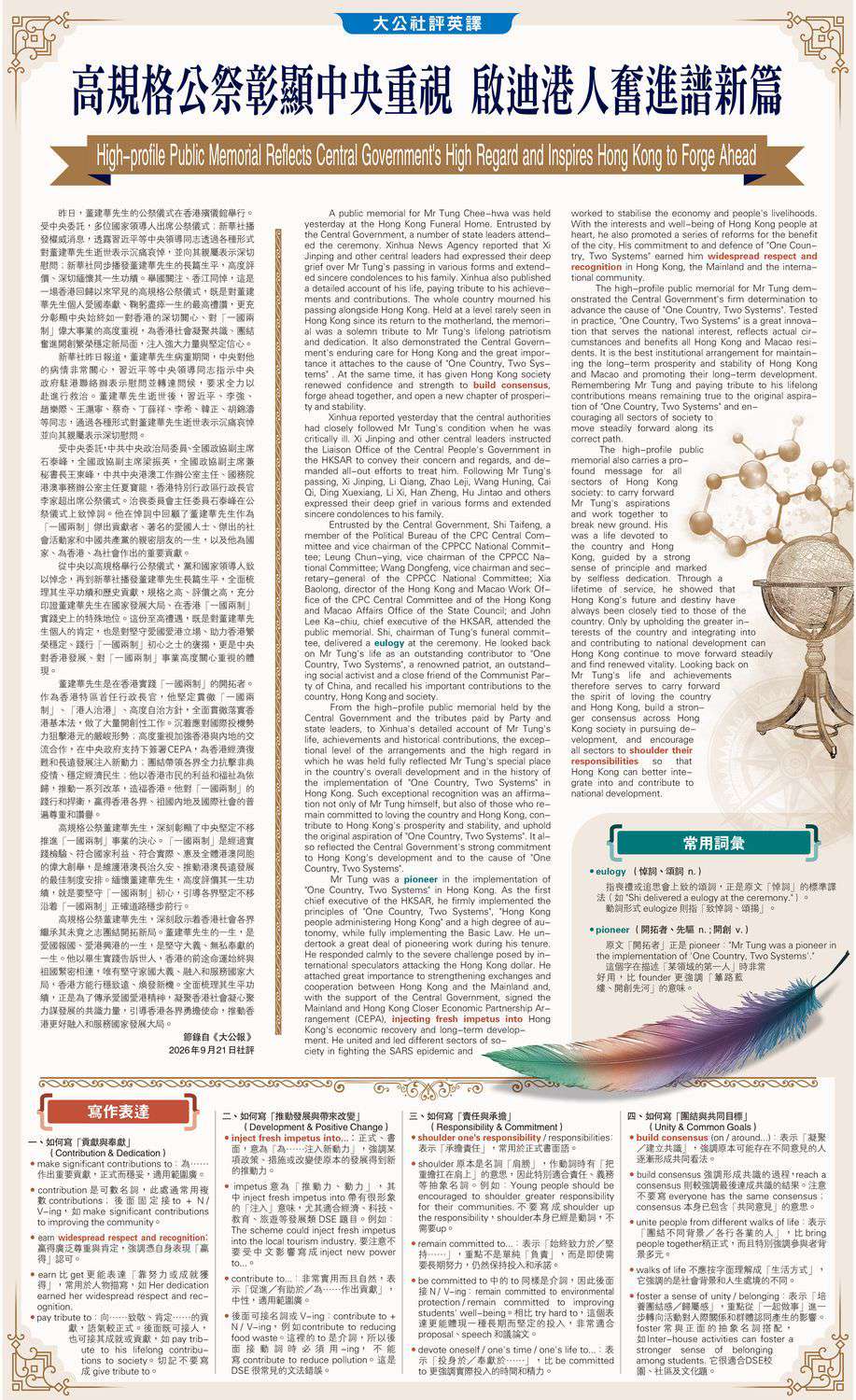
昨日,董建华先生的公祭仪式在香港殡仪馆举行。受中央委托,多位国家领导人出席公祭仪式;新华社播发权威消息,透露习近平等中央领导同志透过各种形式对董建华先生逝世表示沉痛哀悼,并向其亲属表示深切慰问;新华社同步播发董建华先生的长篇生平,高度评价、深切缅怀其一生功绩。举国关注、香江同悼,这是一场香港回归以来罕见的高规格公祭仪式,既是对董建华先生个人爱国奉献、鞠躬尽瘁一生的最高礼赞,更充分彰显中央始终如一对香港的深切关心、对「一国两制」伟大事业的高度重视,为香港社会凝聚共识、团结奋进开创繁荣稳定新局面,注入强大力量与坚定信心。
新华社昨日报道,董建华先生病重期间,中央对他的病情非常关心,习近平等中央领导同志指示中央政府驻港联络办表示慰问并转达问候,要求全力以赴进行救治。董建华先生逝世后,习近平、李强、赵乐际、王沪宁、蔡奇、丁薛祥、李希、韩正、胡锦涛等同志,通过各种形式对董建华先生逝世表示沉痛哀悼并向其亲属表示深切慰问。
受中央委托,中共中央政治局委员、全国政协副主席石泰峰,全国政协副主席梁振英,全国政协副主席兼秘书长王东峰,中共中央港澳工作办公室主任、国务院港澳事务办公室主任夏宝龙,香港特别行政区行政长官李家超出席公祭仪式。治丧委员会主任委员石泰峰在公祭仪式上致悼词。他在悼词中回顾了董建华先生作为「一国两制」杰出贡献者、著名的爱国人士、杰出的社会活动家和中国共产党的亲密朋友的一生,以及他为国家、为香港、为社会作出的重要贡献。
从中央以高规格举行公祭仪式,党和国家领导人致以悼念,再到新华社播发董建华先生长篇生平,全面梳理其生平功绩和历史贡献,规格之高、评价之高,充分印证董建华先生在国家发展大局、在香港「一国两制」实践史上的特殊地位。这份至高礼遇,既是对董建华先生个人的肯定,也是对坚守爱国爱港立场、助力香港繁荣稳定、践行「一国两制」初心之士的褒扬,更是中央对香港发展、对「一国两制」事业高度关心重视的体现。
董建华先生是在香港实践「一国两制」的开拓者。作为香港特区首任行政长官,他坚定贯彻「一国两制」、「港人治港」、高度自治方针,全面贯彻落实香港基本法,做了大量开创性工作。沉着应对国际投机势力狙击港元的严峻形势;高度重视加强香港与内地的交流合作,在中央政府支持下签署CEPA,为香港经济复苏和长远发展注入新动力;团结带领各界全力抗击非典疫情、稳定经济民生;他以香港市民的利益和福祉为依归,推动一系列改革,造福香港。他对「一国两制」的践行和捍卫,赢得香港各界、祖国内地及国际社会的普遍尊重和赞誉。
高规格公祭董建华先生,深刻彰显了中央坚定不移推进「一国两制」事业的决心。「一国两制」是经过实践检验、符合国家利益、符合实际、惠及全体港澳同胞的伟大创举,是维护港澳长治久安、推动港澳长远发展的最佳制度安排。缅怀董建华先生,高度评价其一生功绩,就是要坚守「一国两制」初心,引导各界坚定不移沿着「一国两制」正确道路稳步前行。
高规格公祭董建华先生,深刻启示着香港社会各界继承其未竟之志团结开拓新局。董建华先生的一生,是爱国报国、爱港兴港的一生,是坚守大义、无私奉献的一生。他以毕生实践告诉世人,香港的前途命运始终与祖国紧密相连,唯有坚守家国大义、融入和服务国家大局,香港方能行稳致远、焕发新机。全面梳理其生平功绩,正是为了传承爱国爱港精神,凝聚香港社会凝心聚力谋发展的共识力量,引导香港各界勇担使命,推动香港更好融入和服务国家发展大局。
节录自《大公报》
2026年9月21日社评
High-profile Public Memorial Reflects Central Government's High Regard and Inspires Hong Kong to Forge Ahead
A public memorial for Mr Tung Chee-hwa was held yesterday at the Hong Kong Funeral Home. Entrusted by the Central Government, a number of state leaders attended the ceremony. Xinhua News Agency reported that Xi Jinping and other central leaders had expressed their deep grief over Mr Tung's passing in various forms and extended sincere condolences to his family. Xinhua also published a detailed account of his life, paying tribute to his achievements and contributions. The whole country mourned his passing alongside Hong Kong. Held at a level rarely seen in Hong Kong since its return to the motherland, the memorial was a solemn tribute to Mr Tung's lifelong patriotism and dedication. It also demonstrated the Central Government's enduring care for Hong Kong and the great importance it attaches to the cause of "One Country, Two Systems" . At the same time, it has given Hong Kong society renewed confidence and strength to build consensus, forge ahead together, and open a new chapter of prosperity and stability.
Xinhua reported yesterday that the central authorities had closely followed Mr Tung's condition when he was critically ill. Xi Jinping and other central leaders instructed the Liaison Office of the Central People's Government in the HKSAR to convey their concern and regards, and demanded all-out efforts to treat him. Following Mr Tung's passing, Xi Jinping, Li Qiang, Zhao Leji, Wang Huning, Cai Qi, Ding Xuexiang, Li Xi, Han Zheng, Hu Jintao and others expressed their deep grief in various forms and extended sincere condolences to his family.
Entrusted by the Central Government, Shi Taifeng, a member of the Political Bureau of the CPC Central Committee and vice chairman of the CPPCC National Committee; Leung Chun-ying, vice chairman of the CPPCC National Committee; Wang Dongfeng, vice chairman and secretary-general of the CPPCC National Committee; Xia Baolong, director of the Hong Kong and Macao Work Office of the CPC Central Committee and of the Hong Kong and Macao Affairs Office of the State Council; and John Lee Ka-chiu, chief executive of the HKSAR, attended the public memorial. Shi, chairman of Tung's funeral committee, delivered a eulogy at the ceremony. He looked back on Mr Tung's life as an outstanding contributor to "One Country, Two Systems", a renowned patriot, an outstanding social activist and a close friend of the Communist Party of China, and recalled his important contributions to the country, Hong Kong and society.
From the high-profile public memorial held by the Central Government and the tributes paid by Party and state leaders, to Xinhua's detailed account of Mr Tung's life, achievements and historical contributions, the exceptional level of the arrangements and the high regard in which he was held fully reflected Mr Tung's special place in the country's overall development and in the history of the implementation of "One Country, Two Systems" in Hong Kong. Such exceptional recognition was an affirmation not only of Mr Tung himself, but also of those who remain committed to loving the country and Hong Kong, contribute to Hong Kong's prosperity and stability, and uphold the original aspiration of "One Country, Two Systems". It also reflected the Central Government's strong commitment to Hong Kong's development and to the cause of "One Country, Two Systems".
Mr Tung was a pioneer in the implementation of "One Country, Two Systems" in Hong Kong. As the first chief executive of the HKSAR, he firmly implemented the principles of "One Country, Two Systems", "Hong Kong people administering Hong Kong" and a high degree of autonomy, while fully implementing the Basic Law. He undertook a great deal of pioneering work during his tenure. He responded calmly to the severe challenge posed by international speculators attacking the Hong Kong dollar. He attached great importance to strengthening exchanges and cooperation between Hong Kong and the Mainland and, with the support of the Central Government, signed the Mainland and Hong Kong Closer Economic Partnership Arrangement (CEPA), injecting fresh impetus into Hong Kong's economic recovery and long-term development. He united and led different sectors of society in fighting the SARS epidemic and worked to stabilise the economy and people's livelihoods. With the interests and well-being of Hong Kong people at heart, he also promoted a series of reforms for the benefit of the city. His commitment to and defence of "One Country, Two Systems" earned him widespread respect and recognition in Hong Kong, the Mainland and the international community.
The high-profile public memorial for Mr Tung demonstrated the Central Government's firm determination to advance the cause of "One Country, Two Systems". Tested in practice, "One Country, Two Systems" is a great innovation that serves the national interest, reflects actual circumstances and benefits all Hong Kong and Macao residents. It is the best institutional arrangement for maintaining the long-term prosperity and stability of Hong Kong and Macao and promoting their long-term development. Remembering Mr Tung and paying tribute to his lifelong contributions means remaining true to the original aspiration of "One Country, Two Systems" and encouraging all sectors of society to move steadily forward along its correct path.
The high-profile public memorial also carries a profound message for all sectors of Hong Kong society: to carry forward Mr Tung's aspirations and work together to break new ground. His was a life devoted to the country and Hong Kong, guided by a strong sense of principle and marked by selfless dedication. Through a lifetime of service, he showed that Hong Kong's future and destiny have always been closely tied to those of the country. Only by upholding the greater interests of the country and integrating into and contributing to national development can Hong Kong continue to move forward steadily and find renewed vitality. Looking back on Mr Tung's life and achievements therefore serves to carry forward the spirit of loving the country and Hong Kong, build a stronger consensus across Hong Kong society in pursuing development, and encourage all sectors to shoulder their responsibilities so that Hong Kong can better integrate into and contribute to national development.
常用词汇
•eulogy(悼词、颂词n.)
指丧礼或追思会上致的颂词,正是原文「悼词」的标准译法(如 "Shi delivered a eulogy at the ceremony.")。
动词形式 eulogize 则指「致悼词、颂扬」。
•pioneer (开拓者、先驱n.;开创v.)
原文「开拓者」正是 pioneer:"Mr Tung was a pioneer in the implementation of 'One Country, Two Systems'."
这个字在描述「某领域的第一人」时非常好用,比 founder 更强调「筚路蓝缕、开创先河」的意味。
写作表达
一、如何写「贡献与奉献」(Contribution & Dedication)
•make significant contributions to:为……作出重要贡献,正式而稳妥,适用范围广。
•contribution 是可数名词,此处通常用复数 contributions;后面固定接 to + N / V-ing,如 make significant contributions to improving the community。
•earn widespread respect and recognition:赢得广泛尊重与肯定,强调凭自身表现「赢得」认可。
•earn 比 get 更能表达「靠努力或成就获得」,常用于人物描写,如 Her dedication earned her widespread respect and recognition.
•pay tribute to:向……致敬、肯定……的贡献,语气较正式。后面既可接人,也可接其成就或贡献,如 pay tribute to his lifelong contributions to society。切记不要写成 give tribute to。
二、如何写「推动发展与带来改变」(Development & Positive Change)
•inject fresh impetus into...:正式、书面,意为「为……注入新动力」,强调某项政策、措施或改变使原本的发展得到新的推动力。
• impetus 意为「推动力、动力」,其中 inject fresh impetus into 带有很形象的「注入」意味,尤其适合经济、科技、教育、旅游等发展类 DSE 题目。例如:The scheme could inject fresh impetus into the local tourism industry. 要注意不要受中文影响写成 inject new power to...。
•contribute to...:非常实用而且自然,表示「促进/有助于/为……作出贡献」,中性,适用范围广。
•后面可接名词或 V-ing:contribute to + N / V-ing,例如contribute to reducing food waste。这里的 to 是介词,所以后面接动词时必须用 -ing,不能写 contribute to reduce pollution。这是 DSE 很常见的文法错误。
三、如何写「责任与承担」(Responsibility & Commitment)
•shoulder one's responsibility / responsibilities:表示「承担责任」,常用于正式书面语。
•shoulder 原本是名词「肩膀」,作动词时有「把重担扛在肩上」的意思,因此特别适合责任、义务等抽象名词。例如:Young people should be encouraged to shoulder greater responsibility for their communities. 不要写成 shoulder up the responsibility,shoulder本身已经是动词,不需要up。
•remain committed to...:表示「始终致力于/坚持……」,重点不是单纯「负责」,而是即使需要长期努力,仍然保持投入和承诺。
•be committed to 中的 to 同样是介词,因此后面接 N / V-ing:remain committed to environmental protection / remain committed to improving students' well-being。相比 try hard to,这个表达更能体现一种长期而坚定的投入,非常适合 proposal、speech 和议论文。
•devote oneself / one's time / one's life to...:表示「投身于/奉献于……」,比 be committed to 更强调实际投入的时间和精力。
四、如何写「团结与共同目标」(Unity & Common Goals)
•build consensus (on / around...):表示「凝聚/建立共识」,强调原本可能存在不同意见的人逐渐形成共同看法。
•build consensus 强调形成共识的过程,reach a consensus 则较强调最后达成共识的结果。注意不要写 everyone has the same consensus;consensus 本身已包含「共同意见」的意思。
•unite people from different walks of life:表示「团结不同背景/各行各业的人」,比 bring people together稍正式,而且特别强调参与者背景多元。
•walks of life 不应按字面理解成「生活方式」,它强调的是社会背景和人生处境的不同。
•foster a sense of unity / belonging:表示「培养团结感/归属感」,重点从「一起做事」进一步转向活动对人际关系和群体认同产生的影响。foster 常与正面的抽象名词搭配,如Inter-house activities can foster a stronger sense of belonging among students. 它很适合DSE校园、社区及文化题。