

大公社评英译/历史性元首会晤 指引中美关系新航程
- 字号
- 放大
- 标准
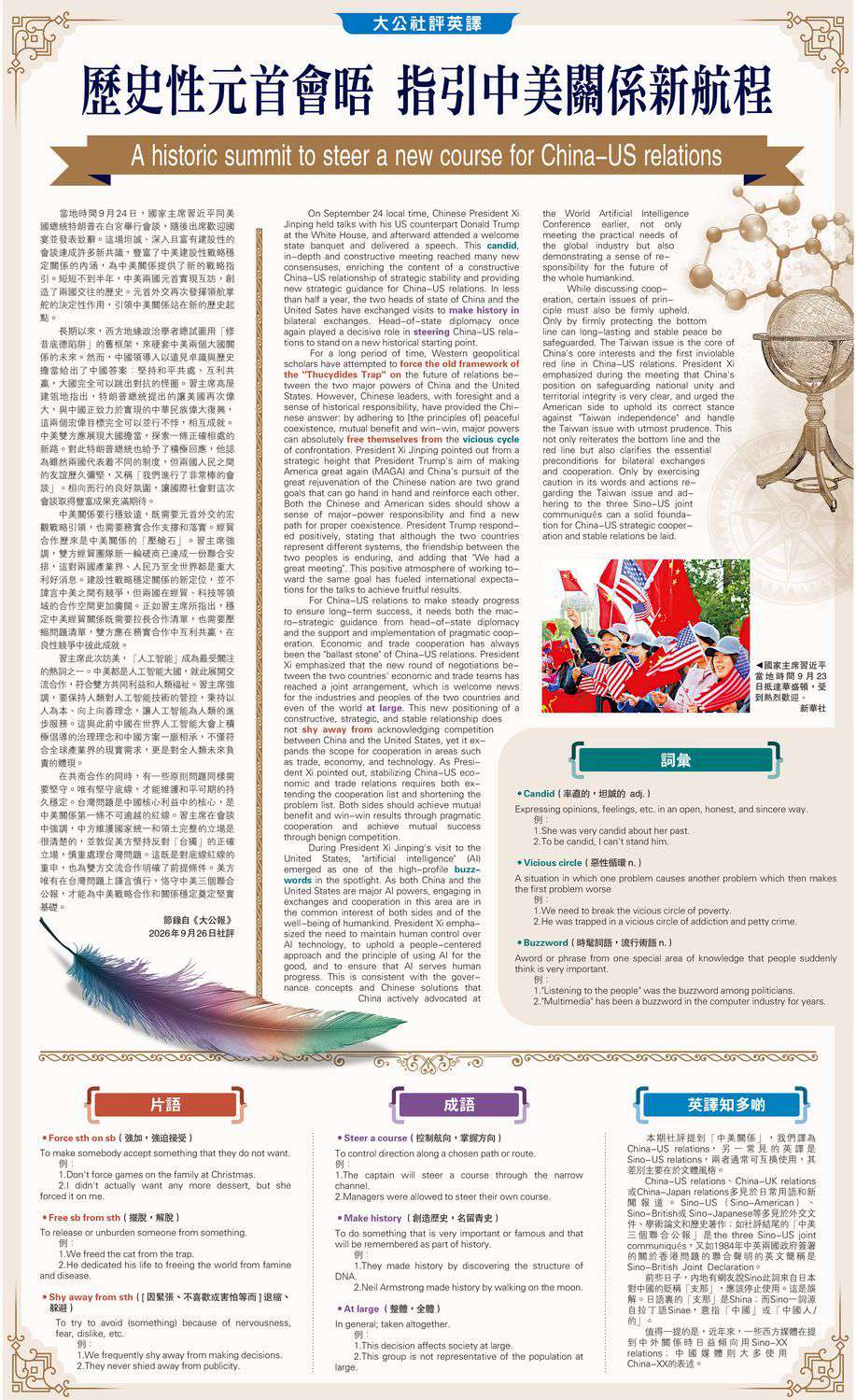
当地时间9月24日,国家主席习近平同美国总统特朗普在白宫举行会谈,随后出席欢迎国宴并发表致辞。这场坦诚、深入且富有建设性的会谈达成许多新共识,丰富了中美建设性战略稳定关系的内涵,为中美关系提供了新的战略指引。短短不到半年,中美两国元首实现互访,创造了两国交往的历史。元首外交再次发挥领航掌舵的决定性作用,引领中美关系站在新的历史起点。
长期以来,西方地缘政治学者总试图用「修昔底德陷阱」的旧框架,来硬套中美两个大国关系的未来。然而,中国领导人以远见卓识与历史担当给出了中国答案:坚持和平共处、互利共赢,大国完全可以跳出对抗的怪圈。习主席高屋建瓴地指出,特朗普总统提出的让美国再次伟大,与中国正致力于实现的中华民族伟大复兴,这两个宏伟目标完全可以并行不悖,相互成就。中美双方应展现大国担当,探索一条正确相处的新路。对此特朗普总统也给予了积极回应,他认为虽然两国代表着不同的制度,但两国人民之间的友谊历久弥坚,又称「我们进行了非常棒的会谈」。相向而行的良好氛围,让国际社会对这次会谈取得丰富成果充满期待。
中美关系要行稳致远,既需要元首外交的宏观战略引领,也需要务实合作支撑和落实。经贸合作历来是中美关系的「压舱石」。习主席强调,双方经贸团队新一轮磋商已达成一份联合安排,这对两国产业界、人民乃至全世界都是重大利好消息。建设性战略稳定关系的新定位,并不讳言中美之间有竞争,但两国在经贸、科技等领域的合作空间更加广阔。正如习主席所指出,稳定中美经贸关系既需要拉长合作清单,也需要压缩问题清单,双方应在务实合作中互利共赢,在良性竞争中彼此成就。
习主席此次访美,「人工智能」成为最受关注的热词之一。中美都是人工智能大国,就此展开交流合作,符合双方共同利益和人类福祉。习主席强调,要保持人类对人工智能技术的管控,秉持以人为本、向上向善理念,让人工智能为人类的进步服务。这与此前中国在世界人工智能大会上积极倡导的治理理念和中国方案一脉相承,不仅符合全球产业界的现实需求,更是对全人类未来负责的体现。
在共商合作的同时,有一些原则问题同样需要坚守。唯有坚守底线,才能维护和平可期的持久稳定。台湾问题是中国核心利益中的核心,是中美关系第一条不可逾越的红线。习主席在会谈中强调,中方维护国家统一和领土完整的立场是很清楚的,并敦促美方坚持反对「台独」的正确立场,慎重处理台湾问题。这既是对底线红线的重申,也为双方交流合作明确了前提条件。美方唯有在台湾问题上谨言慎行,恪守中美三个联合公报,才能为中美战略合作和关系稳定奠定坚实基础。
节录自《大公报》
2026年9月26日社评
A historic summit to steer a new course for China-US relations
On September 24 local time, Chinese President Xi Jinping held talks with his US counterpart Donald Trump at the White House, and afterward attended a welcome state banquet and delivered a speech. This candid, in-depth and constructive meeting reached many new consensuses, enriching the content of a constructive China-US relationship of strategic stability and providing new strategic guidance for China-US relations. In less than half a year, the two heads of state of China and the United Sates have exchanged visits to make history in bilateral exchanges. Head-of-state diplomacy once again played a decisive role in steering China-US relations to stand on a new historical starting point.
For a long period of time, Western geopolitical scholars have attempted to force the old framework of the "Thucydides Trap" on the future of relations between the two major powers of China and the United States. However, Chinese leaders, with foresight and a sense of historical responsibility, have provided the Chinese answer: by adhering to [the principles of] peaceful coexistence, mutual benefit and win-win, major powers can absolutely free themselves from the vicious cycle of confrontation. President Xi Jinping pointed out from a strategic height that President Trump's aim of making America great again (MAGA) and China's pursuit of the great rejuvenation of the Chinese nation are two grand goals that can go hand in hand and reinforce each other. Both the Chinese and American sides should show a sense of major-power responsibility and find a new path for proper coexistence. President Trump responded positively, stating that although the two countries represent different systems, the friendship between the two peoples is enduring, and adding that "We had a great meeting". This positive atmosphere of working toward the same goal has fueled international expectations for the talks to achieve fruitful results.
For China-US relations to make steady progress to ensure long-term success, it needs both the macro-strategic guidance from head-of-state diplomacy and the support and implementation of pragmatic cooperation. Economic and trade cooperation has always been the "ballast stone" of China-US relations. President Xi emphasized that the new round of negotiations between the two countries' economic and trade teams has reached a joint arrangement, which is welcome news for the industries and peoples of the two countries and even of the world at large. This new positioning of a constructive, strategic, and stable relationship does not shy away from acknowledging competition between China and the United States, yet it expands the scope for cooperation in areas such as trade, economy, and technology. As President Xi pointed out, stabilizing China-US economic and trade relations requires both extending the cooperation list and shortening the problem list. Both sides should achieve mutual benefit and win-win results through pragmatic cooperation and achieve mutual success through benign competition.
During President Xi Jinping's visit to the United States, "artificial intelligence" (AI) emerged as one of the high-profile buzzwords in the spotlight. As both China and the United States are major AI powers, engaging in exchanges and cooperation in this area are in the common interest of both sides and of the well-being of humankind. President Xi emphasized the need to maintain human control over AI technology, to uphold a people-centered approach and the principle of using AI for the good, and to ensure that AI serves human progress. This is consistent with the governance concepts and Chinese solutions that China actively advocated at the World Artificial Intelligence Conference earlier, not only meeting the practical needs of the global industry but also demonstrating a sense of responsibility for the future of the whole humankind.
While discussing cooperation, certain issues of principle must also be firmly upheld. Only by firmly protecting the bottom line can long-lasting and stable peace be safeguarded. The Taiwan issue is the core of China's core interests and the first inviolable red line in China-US relations. President Xi emphasized during the meeting that China's position on safeguarding national unity and territorial integrity is very clear, and urged the American side to uphold its correct stance against "Taiwan independence" and handle the Taiwan issue with utmost prudence. This not only reiterates the bottom line and the red line but also clarifies the essential preconditions for bilateral exchanges and cooperation. Only by exercising caution in its words and actions regarding the Taiwan issue and adhering to the three Sino-US joint communiqués can a solid foundation for China-US strategic cooperation and stable relations be laid.
词汇
•Candid(率直的,坦诚的adj.)
Expressing opinions, feelings, etc. in an open, honest, and sincere way.
例:
1.She was very candid about her past.
2.To be candid, I can't stand him.
•Vicious circle(恶性循环 n.)
A situation in which one problem causes another problem which then makes the first problem worse
例:
1.We need to break the vicious circle of poverty.
2.He was trapped in a vicious circle of addiction and petty crime.
•Buzzword(时髦词语,流行术语 n.)
Aword or phrase from one special area of knowledge that people suddenly think is very important.
例:
1."Listening to the people" was the buzzword among politicians.
2."Multimedia" has been a buzzword in the computer industry for years.
片语
•Force sth on sb(强加,强迫接受)
To make somebody accept something that they do not want.
例:
1.Don't force games on the family at Christmas.
2.I didn't actually want any more dessert, but she forced it on me.
•Free sb from sth(摆脱,解脱)
To release or unburden someone from something.
例:
1.We freed the cat from the trap.
2.He dedicated his life to freeing the world from famine and disease.
•Shy away from sth([ 因紧张、不喜欢或害怕等而 ] 退缩、躲避)
To try to avoid (something) because of nervousness, fear, dislike, etc.
例:
1.We frequently shy away from making decisions.
2.They never shied away from publicity.
成语
•Steer a course(控制航向,掌握方向)
To control direction along a chosen path or route.
例:
1.The captain will steer a course through the narrow channel.
2.Managers were allowed to steer their own course.
•Make history (创造历史,名留青史)
To do something that is very important or famous and that will be remembered as part of history.
例:
1.They made history by discovering the structure of DNA.
2.Neil Armstrong made history by walking on the moon.
•At large (整体,全体)
In general; taken altogether.
例:
1.This decision affects society at large.
2.This group is not representative of the population at large.
英译知多啲
本期社评提到「中美关系」,我们译为China-US relations,另一常见的英译是Sino-US relations,两者通常可互换使用,其差别主要在于文体风格。
China-US relations、China-UK relations或China-Japan relations多见于日常用语和新闻报道。Sino-US(Sino-American)、Sino-British或 Sino-Japanese等多见于外交文件、学术论文和历史著作;如社评结尾的「中美三个联合公报」是the three Sino-US joint communiqués,又如1984年中英两国政府签署的关于香港问题的联合声明的英文简称是Sino-British Joint Declaration。
前些日子,内地有网友说Sino此词来自日本对中国的贬称「支那」,应该停止使用。这是误解。日语里的「支那」是Shina;而Sino一词源自拉丁语Sinae,意指「中国」或「中国人 / 的」。
值得一提的是,近年来,一些西方媒体在提到中外关系时日益倾向用Sino-XX relations;中国媒体则大多使用China-XX的表述。